Located in County Clare, between the towns of Lahinch and Ennistymon, sits the memorial “An Gorta Mór” by Alan Ryan Hall. The monument is located between the local workhouse at Ennistymon and the site of a mass grave.
There was still more about the history of Lahinch that I wanted to share yesterday, but I feared the post would get too long, so I'm adding the extras into today's post.
One of the defining events of Irish history is An Gorta Mor - commonly known as the Great Potato Famine. The picture above is located just outside Lahinch on the road to Ennistymon and is found opposite the mass grave in the paddock across the road.
These pics contain the explanation of the Great Hunger - sorry about the quality and my reflection in each one!!!!
The Famine in Ireland
Map of the area including the Mass Graveyard
Memorial Stone
Paddock where the Mass Graveyard is found
Emigration and the Famine
Ennistymon Union and the Great Famine
It's so hard to imagine how horrible this time must have been,
The Great Famine (Irish: an Gorta Mór[ənˠ ˈɡɔɾˠt̪ˠə ˈmˠoːɾˠ]), also known within Ireland as the Great Hunger or simply the Famine and outside Ireland as the Irish Potato Famine,[1][2] was a period of starvation and disease in Ireland from 1845 to 1852 that constituted a historical social crisis which subsequently had a major impact on Irish society and history as a whole.[3] With the most severely affected areas in the west and south of Ireland, where the Irish language was dominant, the period was contemporaneously known in Irish as an Drochshaol,[4] literally translated as "the bad life" (and loosely translated as "the hard times"). The worst year of the period was 1847, which became known as "Black '47".[5][6] During the Great Hunger, roughly 1 million people died and more than 1 million fled the country,[7] causing the country's population to fall by 20–25% (in some towns falling as much as 67%) between 1841 and 1871.[8][9][10] Between 1845 and 1855, at least 2.1 million people left Ireland, primarily on packet ships but also on steamboats and barques—one of the greatest exoduses from a single island in history.[11][12]
The information there states that the Great Famine lasted from 1845 until 1852.
Our Great Grandfather - John Curtin - emigrated in 1855, aged approx 24 years (we are still unsure of his birth date!), so our family must have been involved in this awful time.
You have to wonder how much that famine affected his decision to emigrate.
He had six siblings and his brother Michael had inherited the farm, so I guess there were not too many options open to him.
Antoinette at the Clare Genealogy Centre suggested that he would have been a prime candidate for emigration to Australia. He was a young married farmer with one baby and Australia was screaming out for people to work the land, after they no longer imported convicts. Apparently they were given free passage to Australia.
It's amazing how this event about 12 000 kms away led to the Curtain family today as we know it!
Smother
The other thing I wanted to share today was related to the TV program "Smother"
I'm not sure if any of you saw it, but it is based in Lahinch.
Apart from the story, I just watched it to see all the scenery around Lahinch.
Nice little video about behind the scenes filming of Smother.
But there's a connection between that story and our family!
Moy House - used in Smother
Moy House is a Georgian country house hotel in County Clare, Ireland, about 3 kilometres south of Lahinch off the N67 road near the village of Moy. Originally set in 15 acres of woodland on the River Moy, it was built in the mid 18th century as the holiday home of Sir Augustine Fitzgerald.Wikipedia
According to Antoinette at the Clare Genealogy Centre, that gentleman - Sir Augustine Fitzgerald - was the landlord of the Curtin farm at Tullygarvan. One thing I'm not sure of is how did the family come to own the land, after being tenants for so long??? Might need a bit more research for that.
Once again it has a connection to the Rineen Ambush..
Last night, a new thriller drama called Smother aired on RTÉ. It was filmed around Lahinch, and the location of the main house in the story is the beautiful Moy House, which is in the townland of Carrowgar, just outside Lahinch. Moy House, which overlooks Cregg Beach, was built in the early 1800s. It was initially the summer residence of Sir Augustine Fitzgerald of Carrigoran, Newmarket-on-Fergus. By the end of the 19th century Major George Studdert was living there, until he died in 1909. In April 1933, there was a failed attempt to burn Moy House, just before an A.C.A (Army Comrades Association) dance was due to be held there. Petrol was sprinkled over the floors and furniture of the downstairs rooms, and there were several marks where a light had been applied but failed to ignite. The owner at the time was Margaret Lehane, but the house had been unoccupied for some years. Margaret’s husband Dan and son Patrick had been murdered in their former residence in Cregg, by the Black and Tans, after the Rineen Ambush in 1920.
The follow up comments are quite interesting too, if you have the time to peruse them.
Meanwhile back to today...
These last few days I have experienced an important part of the Irish culture - how Lahinch deals with the death of one of the community.
The gentleman who died was Donal Kenny - owner of the Kenny Woolen Mills shop in the main street, and his son owns Kenny's Bar which I have frequented a few times for my Smithwicks.
When Mr Kenny died, the first I noticed was that the shop was closed.
Then the next day a black ribbon was attached to the door of both the shop and the pub.
Black Ribbon and Funeral Notice on the door of the shop
Black Ribbon and Funeral Notice on the door of the pub
So as noted on the Notice, they brought him to the Church at 6pm. Now the Angelus Bell goes religiously at 12 noon and 6pm. But this was a different toll... reminded me of "For whom the bell tolls". So I went out to have a look. And people were everywhere, but especially gathered around the steps to the Church. And the entire staff of Kenny's pub were standing outside that establishment, as were the staff of the Woollen Mills. They stopped the hearse outside his shop and they carried the coffin up to the Church. I took a little video - I hope it's not disrespectful, but it does showcase the Irish culture in a very real way.
So it seems that after the coffin is brought into the Church, people offer their condolences to the family and then prayers are said. Then the actual funeral Mass is held tomorrow at noon.
There is a certain reverence about his death, that the whole town acknowledges.
People are very close knit in this village, and although everyone knows everybody's business, it's at times like these, that the bonding is very evident.
May his soul rest in peace.
I also went to Doolin this afternoon, but I think I'll leave that until tomorrow!
Over the course of this blog I have shown a few snapshots of Lahinch town, but I thought I would try to get few extra things that capture the essence of this wonderful little village.
I have come at a great time! The weather has been amazing, and the main bunch of tourists have not yet arrived!! They're starting to spruce up the town after the winter rains..
They've painted the Atlantic Hotel
But let's just recap a little history - some of which will echo yesterday's story about Ennistymon.
Lahinch is best described in the literal translation of its name, "Leath Inis", or the "Half Island." This colourful description of the village is borne out by the Atlantic to the west, the Inagh River to the north and the smaller Moy River to the south. The official name, in Irish, is Leacht Ui Chonchubhair, or O'Connor's Cairn, erected in memory of one of the O'Connor Lords of Corcomroe who was slain by his nephews in 1471. The site of this grave is believed to be at the end of the Main Street.
And a little more about Lahinch from the same source..
Lahinch developed from having just a few cabins in the eighteenth century to having a population of over one thousand people in 1835. However, no significant development took place in the early nineteenth century as the sea front continued to take a severe battering from the Atlantic gales.
Lahinch's popularity and fame depend on two features. First and foremost is the mile-long beach of golden sand stretching along in front of the village, promenade and sandhills. With the growing popularity of sea bathing and the arrival of the West Clare Railway in 1887 people began to arrive in unprecedented numbers. The village's secondary, but by no means lesser, claim to popularity and fame is its Golf Club.
It seems a shame that the West Coast Railway was discontinued. Imagine the trade it could do these days with all the tourists in Lahinch.
The West Clare Railway (WCR) originally operated in County Clare, Ireland, between 1887 and 1961. This 3 ft (914 mm) narrow-gauge railway ran from the county town of Ennis, via numerous stopping-points along the West Clare coast to two termini, at Kilrush and Kilkee, with the routes diverging at Moyasta Junction. The system was the last operating narrow gauge passenger system in Ireland and connected with the mainline rail system at Ennis, where a station still stands today for bus and train services to Limerick and Galway. Intermediate stops included Ennistymon, Lahinch and Milltown Malbay.
The history of Lahinch is similar to that of Ennistymon especially as regards the the Rineen Ambush.
In September 1920, in reprisal for the Rineen Ambush, British troops set fire to many buildings in Lahinch, including the local dance hall near the Promenade.
The other towns that were subjected to the burning were Ennistymon and Miltown Malbay.
The Centenary of the Rineen Ambush was celebrated on September 22 2020
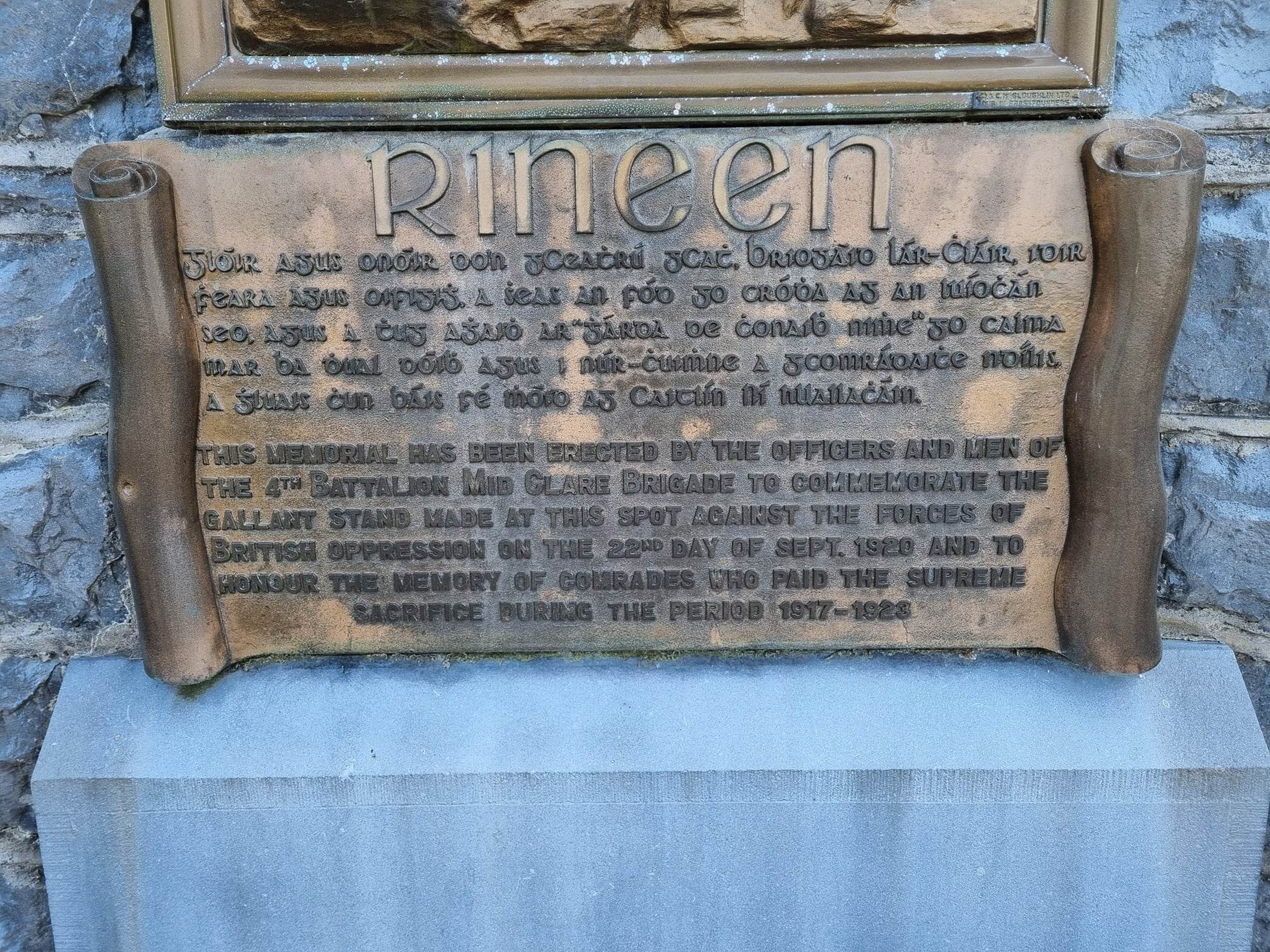
There is a story attached to those pics of the Rineen Ambush Memorial.... Wattle is always having little adventures!!!
I could get a pic of that memorial from Google Images, but having read the history I thought I would go and see it for myself - given that it's not far from Lahinch. So I put it into Google Maps and when I arrived at the spot where it was telling me to go, it showed a dinky little lane that would barely fit my car. So I thought I would just keep going and do a U turn somewhere and come back again... However that road doesn't really lend itself to U turns, so I kept going to Spanish Point...(That was on the blog on Day 19!) I went into the Armada Hotel, because it was lunchtime and I thought I could kill 2 birds with one stone. So I asked the guy behind the bar if they did sandwiches and he said No but took me outside to a little cafe where they did serve sandwiches. On the way I asked him if he was a local and did he know about this monument. I struck it lucky because he was right into all that history. He took my iphone and added the Memorial in as a dropped pin. So I thanked him profusely.
But... by the time i had my croissant with ham and cheese I went back to the car and that dropped pin was taking me to Burke's hardware (Hello Andrew and co!) in Miltown Malbay.
So I went back in and there was no sign of Bernard (I had found out his name!) So I asked another young man, who, fortunately, was also right into all that history and he was happily telling me the whole history of the Rineen Ambush and the Black and Tans involvement etc... (I think he was Callum) . He also told me exactly how to get there!
So I was so blessed twice with the lovely Irish lads who helped a damsel in distress!
Long story - but it was the highlight of my day!
On the way home I called in to the Lahinch Golf Club and it was buzzing. It's yet another perfectly splendid day today. The mornings are a bit misty but by lunchtime the sun is out and all the locals are in their short sleeves. (I still think there's a bit of a cool breeze!)
It was founded 131 years ago in 1892 by Alexander W. Shaw and Richard J. Plummer, officials of Limerick Golf Club. They laid out an 18-hole course, the original course had ten holes on each side of the road.[3] It has been described as the "St. Andrew's" of Ireland
Perhaps just one more thing of interest to finish off...
In 2014 there was a huge Hurricane (Hercules) which pounded the Promenade at Lahinch with massive waves.
Hurricane Hercules arrived to Irish west coast on 3rd of January 2014 by 7 PM and Lahinch promenade started to be pounded by giant waves and onshore wind 45 knots strong.
You may have noticed in the pics that I have taken of Lahinch Beach in 2023, the Promenade is now protected by massive big boulders. Apparently this storm did great damage to those houses and shops on the beach front...
Lahinch Beach this morning.
There's so much more I could add, but I still have a few days left!!! But that's a bit of a start. It's hard to explain a place that you have come to know a little better through living in it! But you have to start somewhere!
I thought today I would showcase the next village to Lahinch - Ennistymon - which is about 4 kms East of the town.
Ennistymon is one step up from Lahinch, because it has a supermarket!!! (But it doesn't have a beach!)
Supervalu Supermarket at Ennistymon
Lahinch has the equivalent of a corner store where you can buy the essentials, but most locals go to Ennistymon to do their shopping. That's where I've been shopping since I've been here. It's a little bit like your smaller IGA shops in Perth and beyond, but it has most of the basics. If you want a really big shop you go to Dunnes in Ennis!
Here's a little history of the town..
Edited version of a sign near the Cascades
The attack by the Black and Tans was a reprisal against the IRA after the Rineen Ambush..
The Rineen ambush was an ambush carried out by the Mid Clare Brigade of the Irish Republican Army (IRA) on 22 September 1920, during the Irish War of Independence. The attack took place at Drummin Hill in the townland of Drummin, near the hamlet of Rineen (or Rinneen), County Clare.
The IRA's Mid-Clare Brigade attacked a Royal Irish Constabulary (RIC) lorry, killing six officers. Shortly afterwards, the IRA encountered ten lorry-loads of British Army soldiers, who had been sent out on a separate patrol looking for a missing magistrate. However, the IRA held off this attack long enough to flee the scene in an orderly retreat and sustained only two wounded.[1]
In reprisal for the ambush, the RIC Auxiliaries and British military raided three local villages, killed five civilians and burnt 16 houses and shops in the surrounding area.[2][3]
Here's pic of Brian Merriman, mentioned in the above sign
Poet Brian Merriman
The town has a few quirky shops, so I went and took some pics to give you a bit of an idea. As most towns in rural Ireland, it's built around the main street.
Ennistymon Main Street
Ennistymon Town Square
Byrne's Shop was a bit quirky!
Byrnes Shop
Ennistymon Bakery - had a nice lunch there
Eugene's Pub
Eugene's pub - winner of the James Joyce Pub Award
One more that took my fancy.....
If you remember Wattle's Washing in an earlier post, where I was lamenting the lack of laundromats in Lahinch and beyond, someone recommended this laundromat on the way into Lahinch...
I stopped here to get some petrol, so I couldn't resist taking the picture!!!
Ennistymon Laundromat
At one stage I was discussing this laundromat with Marie and she told me that she was considering taking her doonas there to give them a wash, because the machines were nice and big. But someone warned her off them because she said people washed their horse and dog blankets in there. And sure enough when she went to have a look, there was hair everywhere in the machines! 😫
Another reason to say Thank you Jesus for Marie letting me do my washing at her house. 💓🙏
One of the main attractions of the town is The Cascades, which is a lovely little waterfall that literally sits behind the main street of the town. Parking is very hard in Ennistymon, but to get to the Cascades, I was able to park in the car park of The Falls Hotel which is a popular 4.5 star hotel set in beautiful surroundings.
Here are some pics of The Cascades..
The Cascades
The Cascades
The Cascades
Here's a little video of the Cascades...
So later in the day Marie offered to take me to St Augustine's Well in Kilshanny. You might remember I thought I was visiting this well when I was actually in Kilmaley... but it was the wrong one!
Kilshanny is not far north of Ennistymon and after a few attempts, we finally arrived at where it was situated. It was at the back of a farmhouse, and we literally had to walk through their land to get there. Again we had a few attempts but eventually we got it right!!!
The reason I wanted to go to this well in particular is that it is dedicated to St Augustine and there are a heap of Austins in our family tree, which is shortened form of Augustine!
Here's some pics of the well..
St Augustine's Well
St Augustine's Well - Marie
St Augustine's Well - Moira
You had to dip the saucepan into the water below
It was a long way down!
I thought I might not be able to get up again!!!
It's easy getting down!!!
St Augustine's Statue
St Augustine's Well Gate
It was a beautiful evening and Marie took me for a guided tour around the schools in Ennistymon on the way home. She went to the Mercy School and sadly the Convent of Mercy as fallen into disrepair. So sad to see!
They are currently building a massive big building to combine the National School (Primary School), the Convent School and the Brothers School - still under construction
New school Ennistymon
So once again I've had a lovely day discovering all the local places around me. It was great having Marie as a guide tonight to tell me the local history about various places we passed. Thanks Marie :)